
 USD (US$)
 AUD (AU$)
 CAD (CA$)
 EUR (€)
 GBP (£)
 JPY (¥)
The Nimrod Fortress is the biggest Crusade-era castle in all of Israel, a mountain-top stronghold spanning back to the 13th century. With views of much of the Golan, the Nimrod Fortress is situated on a peak neighboring Israel’s highest and only snow-capped mountain, Mount Hermon. Below the fortress are the lush Banias forests with rivers and waterfalls. The ruins of Nimrod Fortress are beautiful and well-preserved, a truly visible snapshot of history.
About the Nimrod Fortress
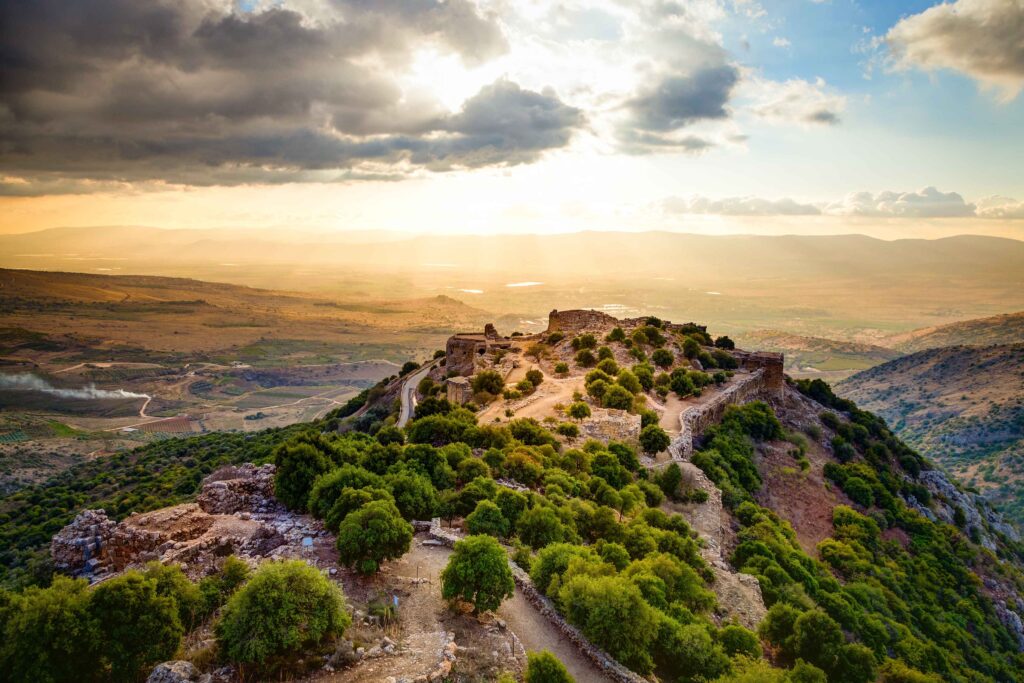
Within the Nimrod Fortress, each place of interest is marked with signs. From the western section, where most of the antiquities are found, to the upper eastern section, the oldest part, 13 marked sites are to be seen on the route. Starting with the northwest tower, a collection of rooms and arches are seen. Next, after seeing the Baybars Inscription, is the Western Tower. Then, the Southwest Tower and the Large Reservoir - a spectacular indoor reservoir pool within an arched room, are to be enjoyed. Continuing, the “Beautiful Tower” can be found. Crossing the dry Moat, the Donjon (Keep) is next. Atop the Keep, one enjoys stunning views of both the fortress and the surrounding area. Returning to the western section, the Prison Tower can be visited and when you want to “escape” you can sneak through the Secret Passage, which opens up to where the route started. This can take up to several hours, depending on how long one spends admiring the magnificent architecture.
The Nimrod Fortress National Park, containing the fortress and the forested mountain on which it rests, covers a total of 195 dunams (49 acres). Hidden in the land and accessible either by walking down from the fortress or up from the main road, a huge pool can be found.
The Nimrod Fortress once controlled the region’s road which began in Tyre (part of modern-day Lebanon) and ran down the Mediterranean coastline, through the Hula Valley and Banias on the way to Damascus. The fortress is named after Nimrod, the great warrior from Biblical times, who was also rumored to have built his castle up on the mountain. Thousands of years later when the Crusaders lost to Saladin, the nephew of Saladin, al-Aziz Othman, built up the eastern section of the fortress. Throughout the next 50 years, the fortress was enlarged and improved. Bilik of the Mamelukes finished off the building in the year 1275 and signed his work with a glorious stone inscription, still seen today.
The Nimrod Fortress is undoubtedly one of the highlights of the Golan and is worth a visit.
Visiting the Nimrod Fortress
Opening Hours
October to March: Saturday to Thursday: 8 am-4 pm and Friday: 8 am-3 pm
April to September: Saturday to Thursday: 8 am-5 pm and Friday: 8 am-4 pm
Ticket Prices
Adult: NIS 24
Child: NIS 10
Groups of 30+ qualify for special rates. Adults: NIS 20, Children NIS 9
Directions to Nimrod Fortress
From Kiryat Shmona, take Road 99, then turn north onto Road 989 to reach the fortress
Contact
Phone: 04-694-9277


